
Business Resilience & Leadership Stress Testing Day
Don’t Just Ask “What If?” Test It.
We pressure test your business before reality does.
Most business risks do not become expensive because nobody knew they were possible. They become expensive because the organisation had never tested how it would respond.
Most organisations believe their people, systems, processes, and leadership structures will hold under pressure. The real question is: have you tested that assumption?
A Business Resilience & Leadership Stress Testing Day gives your organisation a practical, structured way to test how well your leaders, teams, systems, and processes respond when something unexpected happens.
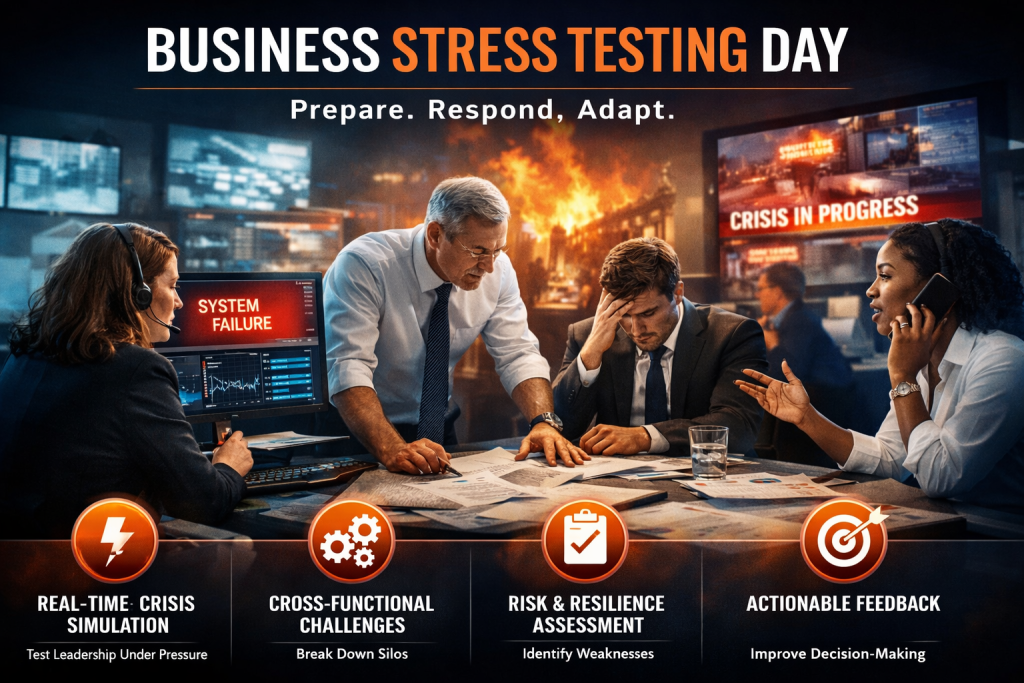
This is not a theoretical workshop or a generic risk discussion. It is a live, facilitated business simulation designed around your organisation’s context. We introduce realistic disruption, observe how your team responds, and help you identify what works, what breaks down, and what needs to improve before a real incident exposes the gaps.
For SMEs, founders, growing businesses, and management teams, this can be the difference between hoping your business is resilient and knowing where it needs to be stronger.
Most business risks do not become expensive because nobody knew they were possible. They become expensive because the organisation had never tested how it would respond.
Most organisations believe their people, systems, processes, and leadership structures will hold under pressure. The real question is: have you tested that assumption?
A Business Resilience & Leadership Stress Testing Day gives your organisation a practical, structured way to test how well your leaders, teams, systems, and processes respond when something unexpected happens.
This is not a theoretical workshop or a generic risk discussion. It is a live, facilitated business simulation designed around your organisation’s context. We introduce realistic disruption, observe how your team responds, and help you identify what works, what breaks down, and what needs to improve before a real incident exposes the gaps.
For SMEs, founders, growing businesses, and management teams, this can be the difference between hoping your business is resilient and knowing where it needs to be stronger.

Who is this for?
This service is ideal for SME founders, business owners, and leadership teams who want to understand whether their organisation can keep operating under pressure. It is especially valuable where the business depends heavily on a small number of key people, systems, suppliers, or customer relationships.
It is also highly relevant for growing businesses that are becoming more complex. As organisations scale, informal ways of working often become stretched. A stress testing day helps reveal whether your decision-making, communication, escalation, and operational processes are ready for the next stage of growth.
For junior and middle managers in larger organisations, the day provides practical experience in leadership under pressure. Participants practise escalation, coordination, communication, decision-making, and accountability in a safe environment before they face similar pressures in real life.
For senior leadership teams, the exercise provides a clear view of how the organisation responds when normal plans are disrupted. It highlights leadership behaviours, decision bottlenecks, communication gaps, ownership issues, and practical risks that may not appear in a standard meeting or risk register.
What you leave with
After the session, your organisation will have a clearer understanding of:
What Businesses have booked a Stress Testing Day for?
Some scenarios fit more than one category. For example, systems failure, cyber or data events, and key personnel loss can be tested at SME, management, or executive level. The difference is the focus of the exercise. For SMEs, the focus is business continuity. For managers, it is operational response. For executives, it is strategic risk, governance, reputation, and decision-making.
Therefore some scenarios fit more than one category. Our customers have booked a stress testing day to evaluate their response to some of the following scenarios:
SME Resilience Test
These are most relevant to founders, business owners, and small or medium-sized businesses where resilience often depends on key people, core systems, cash flow, suppliers, and customer relationships.
Management Pressure Lab
These are best suited to junior and middle managers who need to practise decision-making, communication, escalation, prioritisation, conflict handling, and delivery under pressure.
Executive Scenario Stress Test
These belong at senior leadership, board, or executive level because they involve strategic risk, reputation, regulatory exposure, market conditions, organisational resilience, and cross-functional decision-making.
How the day works
1 Foundational Context
We begin by understanding your organisation. This includes your operating model, key processes, decision-making structure, escalation routes, systems, stakeholders, and known risks. The aim is to ensure the exercise reflects your real business rather than a generic scenario.
2 Live Scenario Simulation
We then introduce a controlled disruption. This may involve a simulated system failure, sudden loss of key personnel, conflicting stakeholder demands, reputational pressure, operational disruption, or a fast-moving business incident. Participants are required to respond in real time, make decisions, communicate clearly, coordinate action, and manage the situation as it develops.
3 Practical Observation & Feedback
Throughout the exercise, we carefully observe how decisions are made and communicated under pressure. We assess the clarity of judgement, the effectiveness of communication, the coordination between functions, and the emotional composure demonstrated by leaders as the scenario unfolds. We also examine levels of accountability and ownership. In other words, who steps forward, how responsibility is assumed, and how decisions are carried through. Participants receive feedback, enabling them to reflect, adjust, and strengthen their leadership approach for the future.
4 Feedback, Consolidation, & Risk Mapping
At the conclusion of the day, we translate experience into actionable improvement. The insights gained during the simulation are consolidated into a clear, structured summary that highlights identified operational vulnerabilities, key behavioural development themes, and any structural weaknesses that may have emerged. Most importantly, you leave with practical mitigation actions and tangible steps designed to strengthen resilience, improve performance, and reduce future risk.
We begin by understanding your organisation. This includes your operating model, key processes, decision-making structure, escalation routes, systems, stakeholders, and known risks. The aim is to ensure the exercise reflects your real business rather than a generic scenario.
2 Live Scenario Simulation
We then introduce a controlled disruption. This may involve a simulated system failure, sudden loss of key personnel, conflicting stakeholder demands, reputational pressure, operational disruption, or a fast-moving business incident. Participants are required to respond in real time, make decisions, communicate clearly, coordinate action, and manage the situation as it develops.
3 Practical Observation & Feedback
Throughout the exercise, we carefully observe how decisions are made and communicated under pressure. We assess the clarity of judgement, the effectiveness of communication, the coordination between functions, and the emotional composure demonstrated by leaders as the scenario unfolds. We also examine levels of accountability and ownership. In other words, who steps forward, how responsibility is assumed, and how decisions are carried through. Participants receive feedback, enabling them to reflect, adjust, and strengthen their leadership approach for the future.
4 Feedback, Consolidation, & Risk Mapping
At the conclusion of the day, we translate experience into actionable improvement. The insights gained during the simulation are consolidated into a clear, structured summary that highlights identified operational vulnerabilities, key behavioural development themes, and any structural weaknesses that may have emerged. Most importantly, you leave with practical mitigation actions and tangible steps designed to strengthen resilience, improve performance, and reduce future risk.
What Makes Us Different?
1 Theoretical Foundation
We begin by developing a clear understanding of how your organisation currently operates. This includes reviewing your operating model, mapping escalation pathways, clarifying decision rights, examining governance structures, and identifying underlying risk assumptions. By establishing this foundation, we ensure that the simulation reflects your real organisational context and not a generic scenario so that insights and outcomes are directly relevant to your business.
2 Live Scenario Simulation
Interactive and applied we then introduce controlled disruption to test how your leadership team performs under pressure. This may involve temporarily removing key decision-makers, simulating an operational shutdown, introducing conflicting stakeholder demands, escalating reputational risk, or compressing decision timelines. As the scenario unfolds, leaders are required to respond in real time. In turn, learning how to make decisions, communicate clearly, and coordinate effectively in a dynamic and challenging environment.
3 Practical Observation & Feedback
Throughout the exercise, we carefully observe how decisions are made and communicated under pressure. We assess the clarity of judgement, the effectiveness of communication, the coordination between functions, and the emotional composure demonstrated by leaders as the scenario unfolds. We also examine levels of accountability and ownership. In other words, who steps forward, how responsibility is assumed, and how decisions are carried through. Participants receive feedback, enabling them to reflect, adjust, and strengthen their leadership approach for the future.
4 Consolidation & Risk Mapping
At the conclusion of the day, we translate experience into actionable improvement. The insights gained during the simulation are consolidated into a clear, structured summary that highlights identified operational vulnerabilities, key behavioural development themes, and any structural weaknesses that may have emerged. Most importantly, you leave with practical mitigation actions and tangible steps designed to strengthen resilience, improve performance, and reduce future risk.
We begin by developing a clear understanding of how your organisation currently operates. This includes reviewing your operating model, mapping escalation pathways, clarifying decision rights, examining governance structures, and identifying underlying risk assumptions. By establishing this foundation, we ensure that the simulation reflects your real organisational context and not a generic scenario so that insights and outcomes are directly relevant to your business.
2 Live Scenario Simulation
Interactive and applied we then introduce controlled disruption to test how your leadership team performs under pressure. This may involve temporarily removing key decision-makers, simulating an operational shutdown, introducing conflicting stakeholder demands, escalating reputational risk, or compressing decision timelines. As the scenario unfolds, leaders are required to respond in real time. In turn, learning how to make decisions, communicate clearly, and coordinate effectively in a dynamic and challenging environment.
3 Practical Observation & Feedback
Throughout the exercise, we carefully observe how decisions are made and communicated under pressure. We assess the clarity of judgement, the effectiveness of communication, the coordination between functions, and the emotional composure demonstrated by leaders as the scenario unfolds. We also examine levels of accountability and ownership. In other words, who steps forward, how responsibility is assumed, and how decisions are carried through. Participants receive feedback, enabling them to reflect, adjust, and strengthen their leadership approach for the future.
4 Consolidation & Risk Mapping
At the conclusion of the day, we translate experience into actionable improvement. The insights gained during the simulation are consolidated into a clear, structured summary that highlights identified operational vulnerabilities, key behavioural development themes, and any structural weaknesses that may have emerged. Most importantly, you leave with practical mitigation actions and tangible steps designed to strengthen resilience, improve performance, and reduce future risk.
Why choose Velox Consilium?
Velox Consilium brings together business analysis, leadership development, transformation, governance awareness, data-led thinking, and practical delivery experience.
That means we do not treat stress testing as a box-ticking exercise. We look at the whole system: people, process, technology, leadership, data, governance, communication, and decision-making.
Our approach is practical, constructive, and outcome-focused. We create a safe but challenging environment where leaders and managers can test assumptions, learn quickly, and strengthen the organisation before real pressure arrives.
Ready to find out how your business performs under pressure?
Book a free 60-minute planning call to discuss your organisation, the risks you want to test, and whether a Business Resilience & Leadership Stress Testing Day is the right fit.