

The tempting answer to business continuity is to ask IT for a plan and file it before the year ends. Folder on the shared drive, box ticked, everyone back to their inboxes.
That gives you a document. It doesn’t give you continuity.
The difference shows up on the first bad morning. A compromised system doesn’t stay politely inside the IT department. It holds up orders, stalls customer support, delays payroll, and leaves staff unsure whether it’s safe to log in or whether they should stop work altogether. The consequences land on customers, colleagues, and business partners, and none of them care which team owned the server.
The government’s Cyber Security Breaches Survey 2025/2026 found that 43% of UK businesses, roughly 612,000 organisations, identified a breach or attack in the previous 12 months. Only 25% had a formal incident response plan. That plan is a narrower thing than business continuity, but the gap is instructive. Having one is a start. Whether it works is a separate question, and no survey can answer it for you.
I’d compare three ways of approaching this: the document on the shelf, the IT-led recovery plan, and the service-led rehearsal. I’ll put the same four questions to each. What does it show about dependencies? Who decides what? What do staff and customers actually experience? And what does it cost in effort?
The document on the shelf
This is the most common arrangement, and it isn’t worthless. Insurers, auditors, and some customer contracts ask whether you have a continuity plan, and a written one answers the question. It’s also the cheapest option by a distance, because one person with a template can produce it in a few weeks.
On dependencies, it tends to list systems and suppliers as they were when somebody last had a quiet fortnight. It assumes the key supplier will answer the phone, the key system will be recoverable, and the key person will be in the building. Each assumption is reasonable on its own. Together they describe a crisis in which nothing important goes wrong.
On decisions, it usually names roles rather than people, and some of those roles now belong to somebody who has left. It rarely says who may pause a process, who may tell customers, or who can spend money without a second signature.
Staff and customers get the least from it. The document is written for the person reading it calmly, not the person with forty minutes and no email. And here’s a practical test worth running today: where is the plan stored? If the answer is “on the network”, you’ve kept the spare key inside the house you’re locked out of.
A document is a record of what you think will happen, which is a different thing from knowing.
The IT-led recovery plan
This is a better option, and I’d be unfair to dismiss it. If your critical service is essentially a system, recovery planning matters enormously. Backups, restore order, recovery times, and the ability to rebuild from a clean state are all things only technical people can answer, and they can be tested technically. A restore from backup either works or it doesn’t.
On dependencies, it’s strong on technology and thinner on everything else. A restored system isn’t the same as a working service. You can bring a customer platform back by Thursday and still have nobody who knows how to process refunds by hand in the meantime, or no premises plan for the team who normally sit next to the one terminal that talks to the warehouse.
On decisions, IT will decide the order in which things come back, which is right. But whether to keep taking orders while a system is down, whether to tell customers now or in four hours, and whether to switch payroll to a manual run are business decisions. They tend to fall into the gap between the technical plan and the commercial owner, and nobody notices until they’re needed.
Staff typically hear “systems are down”, which is information, not instruction. Customers hear whatever somebody improvises. Effort is moderate and sits with a small technical group, which is efficient and also a quiet risk, because the plan lives in the heads of the same few people the plan assumes will be available.
It protects the technology. The service is a larger thing than the technology.
The service-led rehearsal
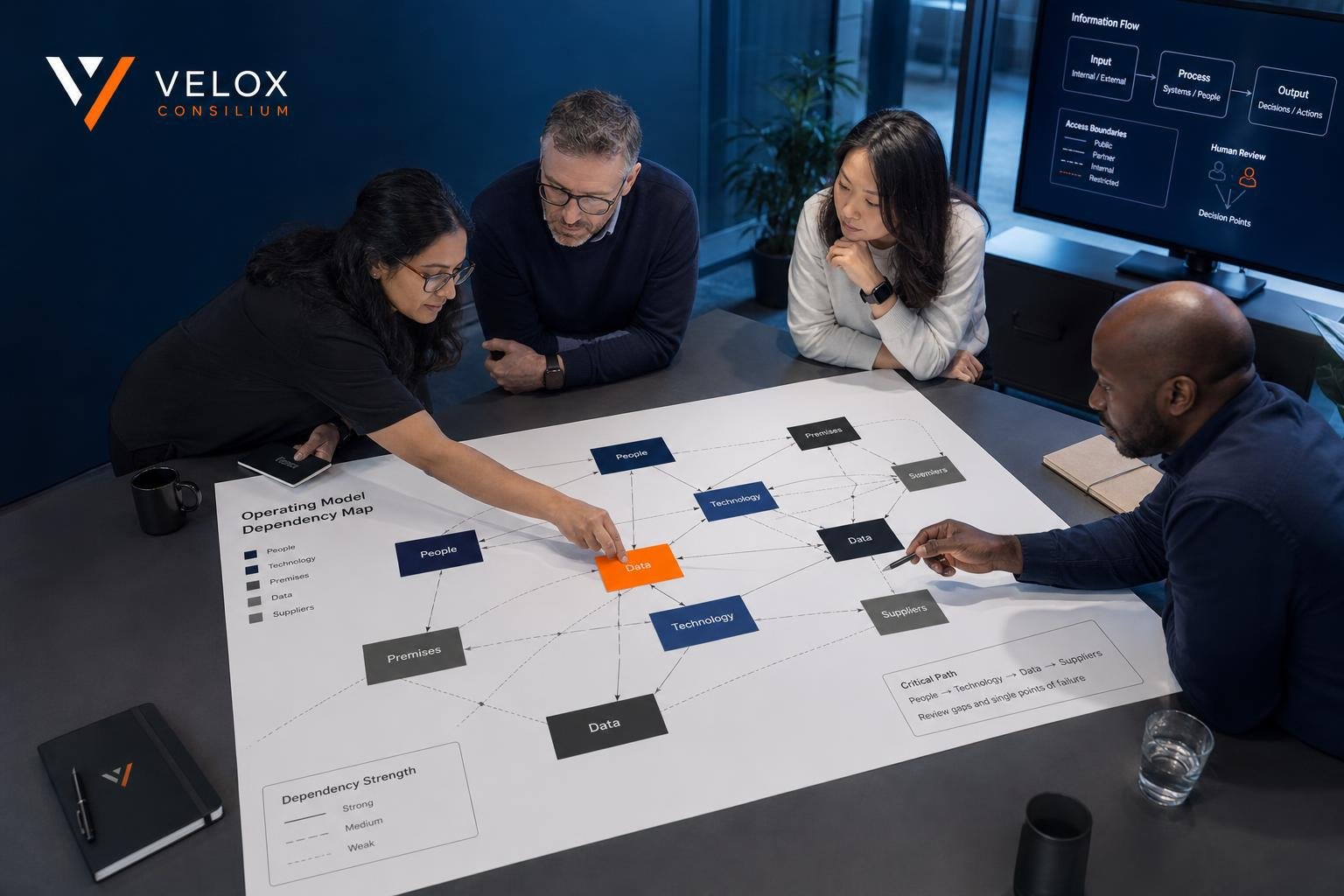
This starts somewhere unfashionable. Pick one service, the one whose failure would hurt most, and map what it relies on. People, technology, premises, data, and suppliers all go on the page, along with what happens when any one of them fails. Then run a realistic scenario against the map. My suggestion would be a cyber incident that takes a customer platform offline for a working day.
That scenario produces concrete questions quickly. Can teams still serve customers, and how? Who decides whether to pause a process, and do they know they’re the person? How do employees receive instructions when email might be the thing that’s down? What do you tell customers, and when?
On dependencies, it’s the only one of the three that looks across the whole service. It’s also where the awkward discoveries come from, which I’ll get to below.
On decisions, it forces the issue in the room, which is where you want it forced. If two directors each assume the other will approve the customer message, you find out over biscuits on a Tuesday, not at 7am during an incident.
On what people experience, it’s the only option where somebody writes the actual instruction to staff and the actual holding message to customers, and then discovers that the draft doesn’t make sense to anyone outside the project. Fix it now.
On effort, it’s measured in hours of senior attention rather than months of project, though you’ll want somebody to prepare the scenario properly. I’d be honest about the downsides. It covers one service, not the whole business. It’s uncomfortable, because it shows you where you’re thin. And it produces a list of findings you then have to prioritise and pay for.
(There’s a small irony here. The most useful output of the exercise is often a printed one-page sheet of who to call and what to do first, kept somewhere that doesn’t need a login. Printing things in 2026 feels like a step backwards. It works.)
What the rehearsal tends to expose
Without claiming to know your business, the weak points in this kind of exercise tend to fall into a few recognisable places, and they’re rarely the ones leaders expected.
One is the single supplier with no alternative, where the contract says nothing helpful about how quickly they’d tell you about their own incident. This is more than a theoretical concern. The Cyber Security and Resilience (Network and Information Systems) Bill, which completed its Lords report stage on 26 October, tightens incident reporting for regulated entities to an initial notification within 24 hours and a full report within 72, and introduces oversight of critical suppliers. If you supply regulated organisations, their contracts and questionnaires may begin asking how you’d cope. Having rehearsed it gives you a better answer than having a document.
Another is the key individual. One person knows how the nightly file transfer works, holds the admin login for the supplier portal, or is the only one who can approve an urgent payment. Everybody knows this vaguely. The map makes it visible, and visible things get funded.
A third is the quiet one: the manual fallback nobody remembers. If a process has been automated for three years, the people who once did it by hand have moved on or forgotten. That applies to AI tools and automated workflows as much as to older systems. Every tool you add to a workflow is a dependency, and a supplier, and a thing that can be unavailable. If your document handling or customer enquiry process now runs through one platform, the map should show what you do when it’s offline, who can access your information in the meantime, and how you’d leave that supplier if you had to. It’s the same exercise wearing a newer badge.
None of this is a reason to avoid automation. It’s a reason to know what the automation rests on.
Which one suits whom
Budgets for 2027 are being set about now, and this is the practical value of the rehearsal. A list of fragile links, each tied to a service that matters, is a far better argument for spending than a general sense that resilience is a good idea. You can compare the cost of a second supplier, a documented manual process, or a cross-trained colleague against the cost of a working day without the service. That’s a decision. “Improve resilience” isn’t.
So here’s where I land.
If you’re an SME or mid-sized organisation without a dedicated continuity function, start with the service-led rehearsal. It produces the document as a by-product, and a document built from a rehearsal is a better document than one built from a template. Do it for one service, then do the next.
If you already have an IT recovery plan, keep it, and put the rehearsal on top. The technical plan answers how systems come back. The rehearsal answers whether the business can keep going while they do.
The document on its own suits nobody, except as the record of what a rehearsal found. Keep it for the insurer. Don’t mistake it for readiness.
For your next leadership meeting, then, one question. Which service would cause the greatest difficulty if it stopped tomorrow, and what would your people need in order to keep it running? Write the answer down before the meeting ends, and print a copy.